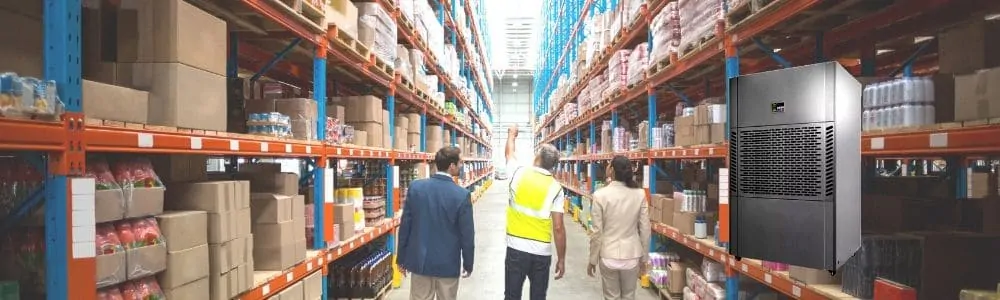
warehouse dehumidifier in UAE.

A warehouse dehumidifier is a high-capacity humidity-control system designed to remove excess moisture from warehouse air and maintain a stable relative humidity (RH). In Dubai and the UAE, warehouse dehumidification systems are particularly important because hot, moisture-laden Gulf air can enter storage facilities through ventilation, building leakage, frequently opened loading docks, airlocks and warehouse doors. Warehouses are especially susceptible because their large volumes and continuous logistics activities allow significant amounts of humid outside air to enter.
Effective warehouse humidity control helps protect cartons, pallets, packaging, electronics, machinery, metal components, pharmaceuticals, food products and other stored inventory from condensation, mould, corrosion, rust, dampness and moisture-related deterioration.
Controlling humidity also supports better indoor air quality by reducing conditions favorable to mould and microbial growth and creating a more controlled environment for personnel and moisture-sensitive goods.
Industrial warehouse dehumidifiers primarily use refrigerant/condensation or desiccant/adsorption technology. A refrigerant dehumidifier draws humid warehouse air across a cold evaporator coil below its dew point. Water vapour condenses into liquid water, which is continuously drained, and drier air is returned to the warehouse. Refrigerant systems are generally energy-efficient for normal-temperature warehouses and perform particularly well in warmer storage environments, typically above approximately 15°C.
A desiccant warehouse dehumidifier uses a moisture-adsorbing rotor, commonly incorporating silica gel, to capture water vapour directly from the air. Desiccant technology is preferred for cold storage warehouses, walk-in chillers, freezer rooms and blast freezers, where conventional condensation dehumidifiers lose capacity as temperatures fall and may experience evaporator icing. Desiccant systems can also achieve much lower RH and dew points for critical storage applications.
Warehouse dehumidification systems are available as portable/mobile, freestanding, ceiling-mounted and ducted dehumidifiers. Portable units provide flexible spot humidity control or temporary drying, whereas permanent ceiling-mounted warehouse dehumidifiers save valuable floor space. Large ducted systems distribute conditioned dry air through supply and return ductwork, helping achieve more uniform humidity and airflow across large logistics facilities and high-bay warehouse layouts.
Correct warehouse dehumidifier sizing should be based on the building’s total cubic volume, not floor area alone. A warehouse with a high ceiling contains substantially more air and therefore potentially more moisture than a low-ceiling building with identical square footage. Final extraction capacity must consider warehouse length, width and height, indoor and outdoor temperature/RH, target humidity, air leakage, fresh-air ventilation, door-opening frequency, airlocks, loading-bay activity, product moisture loads and operating hours. Coastal locations such as Dubai, Sharjah and Abu Dhabi can impose particularly high latent loads, while frequently opened loading-dock doors can introduce large quantities of humid outside air.
The warehouse dehumidifier price in Dubai and UAE depends on required moisture-removal capacity, airflow, refrigerant or desiccant technology, operating temperature, target RH/dew point, controls, installation configuration, ductwork and project conditions. For this reason, commercial and industrial dehumidification systems should be selected from a proper humidity-load calculation rather than liters-per-day capacity or price alone.
With 17+ years of UAE experience, CtrlTech Dehumidifiers – Control Technologies FZE provides engineering, supply, installation and commissioning of industrial dehumidifiers, commercial dehumidifiers, warehouse dehumidifiers, portable/freestanding FSD systems and ceiling-mounted/ducted SPD dehumidification systems. These solutions are engineered for demanding UAE and GCC conditions, including high ambient temperature, extreme coastal humidity, large warehouse volumes and continuous commercial operation.
For businesses searching for a warehouse dehumidifier Dubai, warehouse dehumidifier UAE, industrial warehouse dehumidifier, warehouse humidity control system, warehouse dehumidification system, commercial dehumidifier, industrial dehumidifier, ducted warehouse dehumidifier, ceiling mounted dehumidifier, desiccant dehumidifier, warehouse moisture control, dehumidifier supplier, price, dealer, distributor or warehouse dehumidifier for sale, professional sizing is essential for reliable and energy-efficient humidity control.
Warehouse Dehumidifier Features.
CtrlTech’s storage dehumidifier has a robust design to dry big spaces. Besides, it is available in a massive drying capacity of 240 to 1600 liters per day.

Extra capacity.
The warehouse dehumidifier has a large capacity. Also, it designed with high process airflow.

High-quality, reliable design
It has an inbuilt centrifugal fan, best sensor, and G4 filter. In short, it has the best quality.


Plug and Play
The best part is, it does not need installation as such. It preset ready to plug and start.

Standing warehouse dehumidifier
It is a freestanding unit with compact footprints. Also, it provided with lockable wheels.
Warehouse Dehumidifier Types.
The warehouse dehumidification system can be of portable, floor our ceiling mount type. However, floor mount units often used. For small storage, we can use a portable industrial dehumidifier. But, for a large one, we need to go for a floor or ceiling unit. Preferably, use several machines rather than using a single unit. Point to note, manifold units give redundancy and uniform drying.
For warehouses, CtrlTech recommends their FSD and SPD series. As mentioned before, FSD is a standing unit. In contrast, SPD is a ceiling mount ducted system. FSD series is available up to a capacity of 1600 liters per day. This warehouse dehumidifier designed with extra high airflow. Kindly note, vast spaces need more airflow capacity units. It is easy to install and use with low maintenance. On top of it, FSD units are cheap with reliability.

Benefits of Warehouse Dehumidifiers.
01
It creates dry conditions. Hence, it preserves material like food & medicine.
02
It prevents corrosion. For example, in an airplane hanger, it protects the fleet.
03
Dehumidifiers reduce worker’s fatigue by lowering humidity.
04
These units consume less power. Also, it is easy to install.
05
Warehouse dehumidifiers are compact. Yet, it is powerful.
CtrlTech’s Warehouse Dehumidifier Range
Choose the right CtrlTech warehouse dehumidifier by storage area, capacity and price, from small stockrooms to large warehouses in Dubai and across the UAE.
-

For Small Storage
CDM-50L Commercial Dehumidifier
- Model:
- CDM-50L
- Capacity:
- 50 L/day
- Coverage:
- 30 to 40 m²
From AED 5,600
Shop Now -
For Medium Storage
CDM-90L Commercial Grade Dehumidifier
- Model:
- CDM-90L
- Capacity:
- 90 L/day
- Coverage:
- 50 to 100 m²
From AED 8,900
Shop Now -
For Small Warehouse
SPD-136L Ducted Dehumidifier
- Model:
- SPD-136L
- Capacity:
- 136 L/day
- Coverage:
- 100 to 180 m²
From AED 16,800
Shop Now -
For Large Warehouse
FSD-480L Warehouse Dehumidifier
- Model:
- FSD-480L
- Capacity:
- 480 L/day
- Coverage:
- 200 to 350 m²
From AED 32,500
Shop Now


FAQs About Warehouse Dehumidifiers.
Why are warehouse dehumidification systems important in Dubai?
Warehouse dehumidification systems are important in Dubai because the city’s coastal climate pushes outdoor humidity above 80–90% for much of the year. This moist air enters warehouses through doors, loading bays and gaps in the building, and condenses on cooler floors, racking, stock and equipment. Without control, it leads to mold, rust, damaged packaging, spoiled goods and slippery floors. Dehumidification systems keep indoor humidity at a stable, safe level, typically 45–55% RH, protecting the value of stored goods, extending equipment life, supporting storage compliance and keeping staff safe, which is essential for Dubai’s busy logistics, retail and trading sectors.
What do warehouse dehumidification systems protect storage spaces from in Dubai?
In Dubai, warehouse dehumidification systems protect storage spaces from the damage caused by excess moisture in the air. They prevent condensation from forming on floors, walls, ceilings, racking and products, and stop mold and mildew from growing on cartons, textiles, paper, furniture and food. They protect metal goods, machinery, spare parts and forklifts from rust and corrosion, and keep electronics free from moisture faults. They also prevent cardboard packaging from softening and collapsing, labels from peeling, powders from caking and sensitive products such as pharmaceuticals from losing quality. In addition, they reduce slip hazards and musty odors throughout the facility.
Why is managing indoor air quality important in a warehouse?
Managing indoor air quality in a warehouse is important because the air directly affects the condition of stored goods, the reliability of equipment and the health and safety of staff. High humidity encourages mold spores, bacteria and musty odors, which can contaminate products and affect workers’ health. Damp air also corrodes machinery and electrical systems, increasing breakdowns and maintenance costs. Condensation on floors creates slip hazards. By controlling humidity and keeping the air clean and stable, warehouses protect inventory value, reduce product rejections and returns, meet storage and hygiene standards and provide a safer, more comfortable working environment.
Why are warehouses particularly susceptible to external humidity?
Warehouses are particularly susceptible to external humidity because of the way they are built and used. They have large loading-bay doors that open many times a day, letting in large volumes of humid outdoor air. Their big roof and wall areas, often made of metal panels, can have gaps and joints where air leaks in, and high ceilings create large air volumes that are hard to control. Many warehouses have limited insulation or air conditioning, so indoor conditions closely follow the weather outside. In Dubai’s humid coastal climate, this constant inflow of moist air quickly raises indoor humidity unless a dedicated dehumidification system is installed.
How do frequent loading-bay activities contribute to warehouse humidity?
Frequent loading-bay activities contribute significantly to warehouse humidity because every time a dock door opens, warm, humid outdoor air rushes in and mixes with the indoor air. In busy facilities, doors may be open for long periods as trucks are loaded and unloaded, allowing a continuous flow of moisture inside. Vehicles, pallets and goods arriving from outside also bring moisture with them, and condensation can form on cold products moved in from air-conditioned trucks. In Dubai’s humid climate, this constant moisture load can quickly push warehouse humidity above safe levels. Dock seals, air curtains and properly sized dehumidifiers help control the impact.
How are industrial warehouse dehumidifiers categorized?
Industrial warehouse dehumidifiers are mainly categorized by their operating technology and their mounting configuration. By technology, there are refrigerant, or condensation, dehumidifiers, which suit general warehouses, and desiccant, or adsorption, dehumidifiers, which are needed for cold storage, freezers and very low humidity requirements. By installation, they are available as freestanding or portable units that can be moved where needed, and as permanent ceiling-mounted, wall-mounted or ducted systems that distribute dry air across the whole building. They are also grouped by capacity in liters per day and airflow, matched to each warehouse’s size and moisture load.
How does a refrigerant or condensation dehumidifier remove moisture from warehouse air?
A refrigerant or condensation dehumidifier removes moisture from warehouse air in a continuous cycle. A powerful fan draws humid air from the warehouse into the unit and passes it over a cold evaporator coil chilled by a compressor and refrigerant circuit. As the air cools below its dew point, water vapor condenses into droplets on the coil and drains into a collection tray, then out through a drain hose or condensate pump. The now-dry air passes over a warm condenser coil, which reheats it slightly before it is returned to the warehouse. A humidistat controls the unit, switching it on and off to maintain the target humidity level.
At what warehouse temperatures do refrigerant dehumidifiers work particularly well?
Refrigerant dehumidifiers work particularly well in warehouses kept at moderate to warm temperatures, generally above about 15–18°C, with their best performance in the 20–35°C range common in Dubai and across the UAE. In these conditions, warm, humid air condenses easily on the cold coils, so the dehumidifier removes a large amount of moisture for each unit of electricity it uses. This makes refrigerant units ideal for general storage, distribution centers, retail stockrooms and logistics hubs. Below about 10–15°C, their efficiency drops and the coils may frost, so desiccant dehumidifiers are recommended for cold rooms, chillers and frozen storage areas.
Are refrigerant dehumidifiers energy-efficient for general warehouse storage?
Yes. Refrigerant dehumidifiers are generally the most energy-efficient choice for general warehouse storage at normal ambient temperatures. In warm, humid conditions like those in Dubai, they remove a large volume of moisture for every kilowatt-hour of electricity used, often outperforming desiccant units, which need additional heat to regenerate their drying material. Modern industrial refrigerant models use efficient compressors, large coils and smart humidistats that only run the compressor when needed, further cutting energy use. Correct sizing, good building sealing and regular filter and coil maintenance help these systems operate at peak efficiency and keep running costs low.
How does a desiccant or adsorption dehumidifier remove moisture from warehouse air?
A desiccant or adsorption dehumidifier removes moisture from warehouse air without cooling it. A fan draws humid process air through a slowly rotating wheel coated with a moisture-absorbing material, usually silica gel. The desiccant captures water vapor directly from the air, and the dried air is returned to the warehouse or cold store. At the same time, a separate stream of heated reactivation air passes through another section of the wheel, driving off the collected moisture and exhausting it outside. Because the wheel turns continuously, the desiccant is constantly regenerated. This process works effectively at low and sub-zero temperatures and can achieve very low humidity levels.
What moisture-absorbing material is used in desiccant dehumidifiers?
Silica gel is the moisture-absorbing material used in most desiccant dehumidifiers. It is a highly porous form of silicon dioxide with an enormous internal surface area that attracts and holds water vapor from the air. In industrial desiccant dehumidifiers, silica gel is bonded into a honeycomb rotor, or desiccant wheel, which slowly rotates through the airflow. One part of the wheel absorbs moisture from the process air while another part is dried by heated reactivation air, so the silica gel can be reused continuously. Silica gel is durable, non-corrosive and effective across a wide range of temperatures, making it ideal for cold-storage and low-humidity applications.
Why are desiccant dehumidifiers required for cold-storage facilities, blast freezers, and walk-in chillers?
Desiccant dehumidifiers are required for cold-storage facilities, blast freezers and walk-in chillers because they keep removing moisture at low and sub-zero temperatures where refrigerant units fail. They work by adsorption, not by cooling air below its dew point, so they have no cold coils to freeze. In cold environments, uncontrolled moisture forms frost and ice on evaporators, floors, walls, doors and products, reducing refrigeration efficiency, increasing defrost cycles, damaging packaging and creating serious slip hazards. Desiccant units prevent this ice build-up and condensation, protecting goods, improving energy efficiency and keeping cold-storage operations safe and reliable.
What happens to refrigerant dehumidifiers in cold-storage environments below 10°C?
In cold-storage environments below 10°C, refrigerant dehumidifiers become inefficient and unreliable. Because the room air is already cold, their evaporator coils must run below freezing to condense moisture, so the water vapor freezes onto the coils as frost and ice instead of draining away. This ice blocks airflow and insulates the coils, sharply reducing moisture removal. The unit then spends much of its time in defrost cycles, using energy without dehumidifying, and meltwater may refreeze in drain lines. The extra strain also increases wear on the compressor. For these reasons, desiccant dehumidifiers are the recommended choice for spaces kept below about 10°C.
What warehouse dehumidifier mounting configurations are available?
Warehouse dehumidifiers are available in several mounting configurations to suit different layouts and operating needs. Freestanding or portable units sit on the floor, often on wheels, and can be moved to wherever moisture problems occur. Wall-mounted units are fixed to walls, saving floor space in smaller storerooms. Ceiling-mounted or ceiling-hung units are suspended at high level, keeping floors clear for racking and forklifts. Ducted systems are installed in a plant room, mezzanine or roof area and connected to ductwork that distributes dry air throughout the building. The best configuration depends on warehouse size, layout, ceiling height, available space and the required capacity.
Why might a warehouse use a freestanding or portable dehumidifier?
A warehouse might use a freestanding or portable dehumidifier because it offers flexibility, quick setup and lower initial cost. Portable units need no ductwork or permanent installation; they can simply be wheeled into place, plugged in and connected to a drain or condensate pump. This makes them ideal for smaller warehouses, specific problem areas, temporary storage, seasonal humidity peaks, new or leased premises, and emergencies such as water leaks. They can be moved as stock layouts change or relocated between sites. Portable units are also useful for testing humidity control before investing in a permanent system, or for supplementing an existing system during busy periods.
Why might a warehouse use a permanent ceiling-mounted or ducted dehumidification system?
A warehouse might use a permanent ceiling-mounted or ducted dehumidification system to achieve consistent, building-wide humidity control without taking up valuable floor space. These systems are installed at high level or in a plant room, keeping floors clear for racking, pallets and forklift traffic. Ducted designs distribute dry air evenly across large areas. Permanent systems offer higher capacity, continuous drainage, centralized controls and integration with HVAC and Building Management Systems. They are ideal for large distribution centers and long-term facilities where reliable, low-maintenance humidity control is essential.
How can ceiling-mounted or ducted systems help maintain airflow across large warehouse layouts?
Ceiling-mounted and ducted systems help maintain airflow across large warehouse layouts by distributing dry air from high level throughout the entire space. Ducted systems use supply ducts and diffusers to deliver dry air directly to aisles, racking zones and corners, while return grilles draw humid air back to the dehumidifier for treatment. Ceiling-hung units throw air horizontally across the building, avoiding obstructions from racking and stock. This even circulation prevents stagnant pockets where humidity can build up and condensation or mold can form. The result is uniform humidity conditions from floor to roof, better protection for all stored goods.
Why should industrial dehumidifier sizing be based on total volume rather than basic square footage?
Industrial dehumidifier sizing should be based on total volume rather than basic square footage because warehouses vary greatly in ceiling height. Two buildings with the same floor area can contain very different amounts of air: a warehouse with a 12-meter ceiling holds three times the air volume of one with a 4-meter ceiling. The dehumidifier must treat all of that air, not just the floor area. Sizing by square footage alone usually leads to undersized equipment that cannot reach or hold the target humidity. Calculating cubic volume, then adding the moisture loads from leakage, doors and activity, gives an accurate basis for selecting the right capacity and airflow.
Why is total cubic capacity important when sizing a dehumidifier for a warehouse?
Total cubic capacity is important when sizing a warehouse dehumidifier because it defines the actual amount of air the system must dry and circulate. Calculated by multiplying length, width and height, cubic volume captures the effect of high ceilings and mezzanines that floor area alone ignores. This volume determines the airflow needed to achieve enough air changes per hour and the extraction capacity required to remove moisture from that air. It also influences how much humid outside air enters through leaks and doors. Using cubic capacity as the starting point ensures the dehumidifier is neither undersized, which fails to control humidity, nor oversized, which wastes energy and money.
What factors must the final dehumidifier extraction capacity compensate for?
The final dehumidifier extraction capacity must compensate for all the sources of moisture entering the warehouse, not just the volume of air inside it. Key factors include air leakage through gaps in walls, roofs, doors and joints; the building’s proximity to the coast, where outdoor humidity is higher; activity in airlocks and vestibules; and the frequency and duration of loading-dock door openings. Moisture from goods, staff, vehicles and fresh-air ventilation also counts. Engineers add these loads together, then include a safety margin so the system maintains the desired humidity reliably under real operating conditions.
How can building air leakage affect the required dehumidifier extraction capacity?
Building air leakage can significantly increase the required dehumidifier extraction capacity. Gaps around doors, windows, roof panels, cable entries, wall joints and ventilation openings allow humid outdoor air to seep into the warehouse continuously. In Dubai’s humid climate, this outside air carries a large amount of moisture, which the dehumidifier must remove on top of the moisture already inside. A poorly sealed building may need a much larger system than a well-sealed one of the same size. Sealing gaps, fitting dock seals and air curtains, and maintaining the building envelope can reduce this moisture load, allowing a smaller, more energy-efficient dehumidification system to be used.
How can proximity to coastal areas affect the required warehouse dehumidifier capacity?
Proximity to coastal areas can greatly increase the required warehouse dehumidifier capacity. Warehouses near the Arabian Gulf, such as those in Jebel Ali, Dubai Maritime City, Sharjah ports, are exposed to air with higher moisture content, frequent sea breezes and salt-laden humidity. Every time air enters the building through leaks, doors or ventilation, it brings more moisture than air further inland, raising the dehumidification load. Coastal sites may also need corrosion-resistant equipment. When sizing a system, engineers use local design humidity conditions, so a coastal warehouse typically needs a larger extraction capacity than an identical building located inland.
How can activity in airlocks affect the required dehumidifier extraction capacity?
Activity in airlocks can affect the required dehumidifier extraction capacity because each time people, pallets or vehicles pass through, doors open and humid air moves into the controlled area. Busy airlocks, especially those connecting outdoor areas, loading docks or ambient zones to cold rooms or dry stores, can allow a steady transfer of moisture even when designed to limit air exchange. If both doors are opened together or held open for long periods, the moisture load rises sharply. Engineers account for the number of door openings, traffic levels and airlock size when calculating capacity, and may add dedicated dehumidification in the airlock itself to protect sensitive areas.
How can open loading-dock doors affect the required dehumidifier extraction capacity?
Open loading-dock doors can be the single largest source of moisture in a warehouse, so they have a major effect on the required dehumidifier extraction capacity. Large dock openings allow huge volumes of humid outdoor air to flow in, especially when doors remain open for long periods during loading and unloading. In Dubai’s humid climate, this can add many liters of water per hour to the indoor air. The more doors a facility has, and the longer and more often they are open, the larger the dehumidification system must be. Dock shelters, seals, fast-acting doors and air curtains can reduce infiltration and help lower the required capacity and energy costs.
What factors determine the price of commercial or industrial dehumidification systems?
The price of commercial or industrial dehumidification systems depends mainly on the required extraction capacity and airflow, which are set by the warehouse volume and moisture load. The technology chosen also matters, as desiccant systems for cold storage generally cost more than refrigerant units. Other factors include the mounting configuration, such as portable, ceiling-mounted or ducted; build quality and corrosion protection; control features and Building Management System integration. Installation costs, including ductwork, electrical and drainage work, commissioning, warranty, maintenance contracts and after-sales support also influence the total project cost.
What experience does CtrlTech Dehumidifiers have in the UAE?
CtrlTech Dehumidifiers, operated by Control Technologies FZE, has been supplying dehumidification solutions in the UAE since 2007, giving it more than 17 years of experience in the region’s demanding climate. Based in SAIF Zone, Sharjah, the company serves customers across Dubai, Abu Dhabi, Sharjah and the other Emirates, as well as the wider GCC. Its team designs, supplies, installs and services dehumidifiers for warehouses, factories, swimming pools, cold rooms, pharmaceutical facilities, hotels and homes. This long local experience gives CtrlTech a practical understanding of coastal humidity, high temperatures and the specific moisture challenges faced by facilities in the UAE.
What types of dehumidification systems does CtrlTech engineer?
CtrlTech engineers a wide range of dehumidification systems to suit different applications and building types. Its range includes portable industrial and commercial dehumidifiers, wall-mounted units, ceiling-mounted and ducted systems, and high-capacity floor-standing systems such as the FSD series. It also offers SPD series ducted dehumidifiers for swimming pools, homes and commercial spaces, and desiccant dehumidifiers for cold rooms, chillers and low-humidity applications. CtrlTech can design complete warehouse dehumidification solutions, including sizing, ductwork and BMS integration, and supports each project with installation, commissioning and maintenance services.
What regional conditions are CtrlTech’s FSD and SPD dehumidifier systems designed to handle?
CtrlTech’s FSD and SPD dehumidifier systems are designed to handle the demanding conditions of the UAE and wider GCC region. These include very high outdoor humidity along the Arabian Gulf coast, often above 80–90% in summer, combined with high ambient temperatures and long cooling seasons. The systems are built to run continuously in warm, moisture-laden air, to cope with heavy moisture loads from loading docks, leaky buildings and coastal sea breezes, and to perform reliably for long operating hours. Robust construction and quality components help them resist dust, heat and humidity, making them suitable for warehouses, pools, villas and commercial facilities throughout the region.
Our warehouse dehumidifier clients.


